
What to expect in a session
In my office, you will find everything you would expect in a psychotherapist’s office – classic armchairs, a table with a clock, and a pack of tissues. However, we will also use the free space and additional items that engage the body and encourage movement.
During the session, we combine talk with various forms of building and incorporating contact with the body. I will often invite you to sense what is happening in your body or to get up from the chair and engage in some kind of experience. Sometimes this will involve working with a specific muscle activated in the relationship, related to the psychological function that our conversation concerns, and sometimes it will be an invitation to move freely, in which your body will allow you to find a new answer to an old challenge. However, the therapeutic relationship will always be the basis of our work.
Sometimes we will use objects such as scarves, strings, balls, tape, sticks, paper, and crayons, as well as others that can support what we are working on. You can always try what I suggest or decide that this time you prefer to stay in the conversation. Sometimes we talk for a long time before my client feels ready to try some experience.
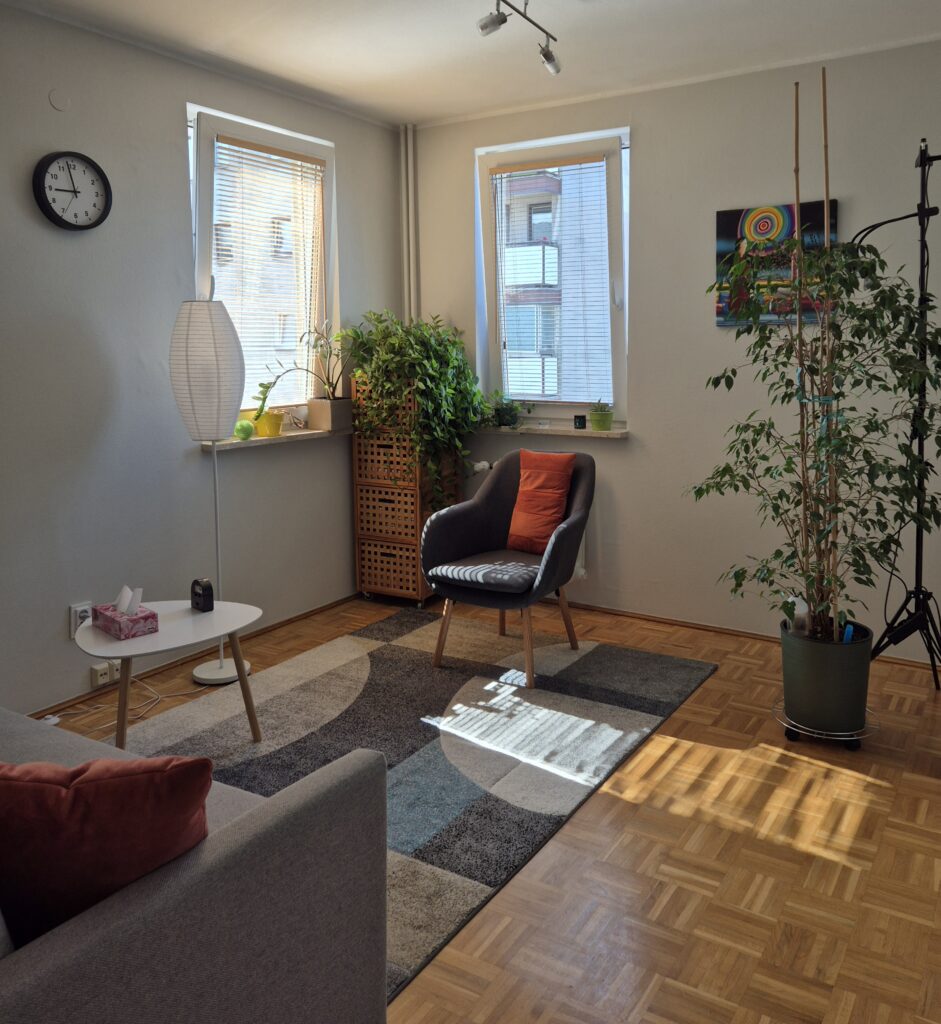
However, I encourage you to slowly open yourself up to this possibility now, before you even meet me.
It is through the connection of the body, emotions, and mind that we can go deeper and create new neural pathways that will allow you to reduce or leave behind various symptoms and be more fully present in your life.
I know that many people find it helpful to read about why the body is important in psychotherapy before deciding to undertake such work. In this case, I recommend a few books that may be of interest to you:
- Alexander Lowen „Depression and the body”
- Besser van der Kolk „The body keeps the score”
- Gabor Maté „When the body says no”
- Peter Levine „Waking the Tiger: Healing Trauma”
- Peter Levine „In An Unspoken Voice”
- Raja Selvam „The Practice of Embodying Emotions”
- Helen Payne, “Dance Movement Psychotherapy Theory, Research and Practice”